Across Europe, artificial intelligence is moving from experimentation to real economic infrastructure. Recent data shows that about 20% of companies in the European Union already use AI technologies, up sharply from less than 8% just a few years ago. Europe is rapidly building a new digital infrastructure designed to support trustworthy artificial intelligence. At the center of this transformation are data spaces, data labs, and AI factories, three complementary layers that together form the foundation of an AI-driven economy.
Recent discussions at the Data Spaces Symposium 2026 highlighted how these components are evolving into an integrated ecosystem. The goal is to ensure that AI development in Europe is not only competitive but also secure, ethical, and compliant with regulatory standards. The emergence of these concepts signals a shift: instead of fragmented AI development pipelines, Europe is moving toward shared infrastructure where data, computing, and governance operate as a unified system.
What Are Data Labs?
Data labs are secure, collaborative environments designed to organize, prepare, and govern data for AI use. Within the EU Data Union strategy, they serve as the “bridge” between data spaces and AI factories by providing structured data capabilities and governance frameworks. In practical terms, data labs:
- Provide controlled access to high-quality datasets
- Ensure data provenance, integrity, and bias mitigation
- Support regulatory compliance (e.g., GDPR and future AI regulations)
- Enable multi-stakeholder collaboration across sectors
For example, AI factories linked to collaborative data spaces allow companies and researchers to develop AI models in trusted environments with strong controls over data ownership and usage. The importance of data labs lies in their role as data preparation and trust infrastructure. Without curated, compliant, and interoperable data, even the most powerful AI systems cannot deliver reliable results.
What Are AI Factories?
AI factories represent the computational and operational layer of the AI ecosystem. Furthermore, they provide: high-performance computing resources, AI development platforms and large scale model training environments. To put it simply, AI factories provide compute infrastructure and human expertise, while data labs structure data and governance, and data spaces enable operational data sharing under common rules.
Despite their potential, AI factories also face important challenges. Building and operating high-performance computing infrastructure is expensive and energy-intensive. Data remains fragmented across Member States, which can limit interoperability. There is also a shortage of specialised AI talent across Europe. SMEs may struggle to access advanced infrastructure. In addition, poorly governed or biased datasets can reduce trust in AI systems. Addressing these issues is essential to ensure that AI factories remain sustainable, inclusive, and aligned with Europe’s long-term digital strategy.
Real-World Sector Applications
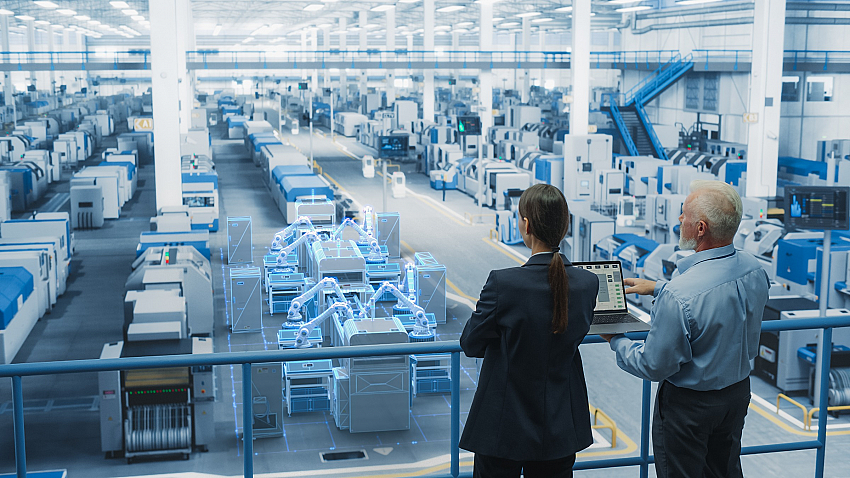
Data spaces, data labs, and AI factories already support many sectors in real life. In manufacturing, shared industrial data helps companies train AI models that match real production conditions and improve efficiency and quality control. In healthcare, secure data environments allow AI systems to be trained using sensitive medical data while still meeting strict privacy and compliance rules. In public administration, data sharing between institutions reduces manual work, supports automated compliance reporting, and helps make public services faster and more efficient.
The future of AI in Europe depends on data labs and AI factories working together. These ecosystems make data secure, usable, and compliant. They allow companies of all sizes to innovate without risk. AI factories turn prepared data into actionable intelligence, while data labs ensure that information is high-quality, trusted, and interoperable. This combination accelerates innovation, reduces costs, and creates a level playing field for SMEs and large corporations alike. Crucially, this infrastructure reflects a distinct European regulatory model shaped by the European Strategy for Data, the General Data Protection Regulation, and the Artificial Intelligence Act. Innovation and compliance are not opposites in Europe instead they evolve together.
The message is clear: The companies that embrace data labs and AI factories today will lead the AI-driven economy of tomorrow. Those who hesitate risk being left behind.