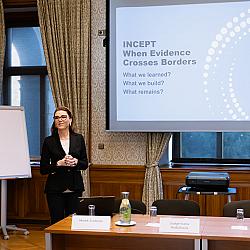
On 23 November 2026, the Law and Internet Foundation (LIF) participated in the Final Conference of the EU-funded INCEPT project – Supporting Cross-border Judicial Cooperation in Cases Related to Interception of Telecommunications, held at the CEELI Institute in Prague, Czech Republic.
The conference brought together judges, prosecutors, legal practitioners, researchers and experts to discuss the legal and practical challenges of cross-border telecommunications interception, the admissibility of electronic evidence and the protection of fundamental rights.
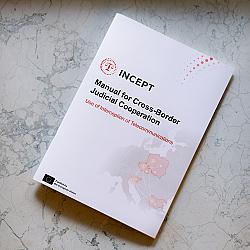
The event also marked an important milestone for INCEPT: the official presentation of the Manual for Cross-Border Judicial Cooperation: Use of Interception of Telecommunications, one of the project's principal outputs.
Strengthening Judicial Cooperation in an Evolving Digital Environment
The conference opened with welcoming remarks by Marek Svoboda, Director of Programs at the CEELI Institute.
Prof. Daniela Ilieva, Executive Director of the Law and Internet Foundation, presented an overview of INCEPT's objectives, activities and principal achievements. As the project's coordinator, LIF has worked alongside its European partners to strengthen the effective application of the European Investigation Order (EIO), particularly in cases involving the interception of telecommunications.
The keynote address was delivered by Judge Ivana Hrdličková, Judge at the High Court of Prague and former President of the Special Tribunal for Lebanon. Entitled “Trusting Evidence You Did Not Collect: A Judge's View of Cross-Border Interception,” the keynote addressed a fundamental challenge in international judicial cooperation: assessing evidence obtained through investigative measures carried out in another jurisdiction.
Presenting the INCEPT Manual: From Research to Practical Guidance
A central part of the conference was dedicated to the presentation of the INCEPT Manual by Dr. Martyna Kusak of Adam Mickiewicz University in Poznań.
Developed through the collective work of the project partners, the Manual builds on comparative legal research, an examination of European and national case law, a practitioner questionnaire and the experience gathered during capacity-building activities in Bulgaria, Czechia, Poland and Slovenia.
It offers practical guidance on the legal instruments applicable to cross-border interception, the distinction between different investigative measures, procedural requirements, judicial authorisation, notification obligations and the admissibility of evidence.
Particular attention is given to Articles 30 and 31 of the EIO Directive, relevant European case law, emerging technological challenges and the safeguards necessary to protect fundamental rights.
Through practical examples, good practices and decision-making tools, the Manual aims to support judges, prosecutors, investigators and legal practitioners in navigating complex cross-border investigations.
The INCEPT Manual is available online: Read the Manual for Cross-Border Judicial Cooperation.
Judicial Practice, Electronic Evidence and Fundamental Rights
The conference continued with two expert panel discussions examining the practical implications of cross-border interception.
The first panel, “Law Enforcement Practitioners – Electronic Evidence and Procedural Rights in Cross-Border Cooperation,” featured Judge Marieta Nedelcheva from Bulgaria and Prosecutor Anna Skrzypczak from Poland, with Dr. Martyna Kusak serving as moderator. The session explored issues at the intersection of investigative practice, judicial cooperation and procedural safeguards.
The afternoon panel, “From Interception to Evidence: Cross-Border Cooperation, Encryption and Fundamental Rights,” brought together Chryssa Mela, Executive Director of Fair Trials, and Václav Stupka, Researcher at Masaryk University, under the moderation of Martin Jančar from the Science and Research Centre Koper.
The discussion addressed the challenges posed by encryption and evolving communications technologies, alongside the importance of ensuring that investigative effectiveness is balanced with privacy, defence rights and other fundamental safeguards.
The conference concluded with reflections from Marek Svoboda and Prof. Daniela Ilieva on the project's contributions and the continuing need for dialogue and cooperation among European judicial professionals.
Building on INCEPT's Results
Implemented between January 2025 and December 2026, INCEPT has combined comparative legal research, practitioner consultation, methodology development and specialised training to address gaps in the cross-border application of telecommunications interception measures.
The consortium organised eight national and two international capacity-building events, creating opportunities for judicial professionals from different Member States to exchange experiences, discuss practical cases and identify common challenges.
As INCEPT approaches the end of its implementation period, its Methodology and Manual provide a foundation for continued professional learning and more consistent approaches to cross-border judicial cooperation.
The Law and Internet Foundation extends its appreciation to all project partners, speakers and participants for their contributions to the conference and the project as a whole.
About INCEPT
INCEPT is coordinated by the Law and Internet Foundation (Bulgaria) in partnership with the CEELI Institute (Czech Republic), Adam Mickiewicz University in Poznań (Poland) and the Science and Research Centre Koper (Slovenia).
The project is funded by the European Union under the Justice Programme, Grant Agreement No. 101192923.
Funded by the European Union. Views and opinions expressed are those of the author(s) only and do not necessarily reflect those of the European Union or the European Commission. Neither the European Union nor the European Commission can be held responsible for them.