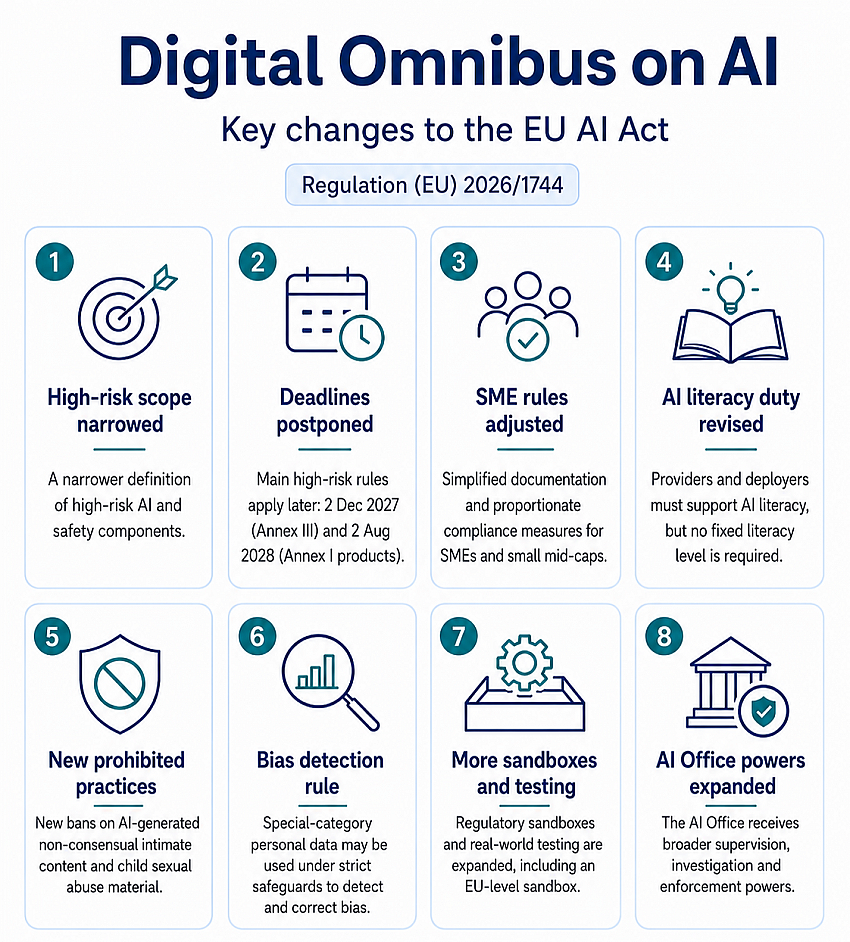
The European Union's Artificial Intelligence Act (AI Act), widely regarded as the world's first comprehensive legal framework governing artificial intelligence, represents a step in regulating AI technologies based on their level of risk. Although the Regulation entered into force only recently, and many of its obligations have yet to become fully applicable, the European Commission has proposed targeted amendments through the Digital Omnibus on AI (Regulation 2026/1744), which was published on the Official Journal of the EU on the 24th of July 2026.
Those amendments are intended to facilitate its implementation rather than alter its fundamental objectives. They reflect a broader shift in the EU's regulatory approach—one that aims to simplify compliance, reduce administrative burdens, and strengthen Europe's competitiveness in the rapidly evolving AI market, as outlined in the European Commission's Digital Omnibus on AI initiative.
Why is the AI Act being amended?
Over the past years, the European Union has adopted an ambitious digital regulatory framework, including the General Data Protection Regulation (GDPR), the Digital Services Act (DSA), the Digital Markets Act (DMA), the Data Act, the Cyber Resilience Act, and the AI Act. While these initiatives have established the EU as one of the leaders in digital regulation, they have also created new obligations for businesses operating across multiple regulatory regimes to comply with.
Recognizing these challenges, the European Commission launched the Digital Omnibus package to simplify the implementation of existing legislation, reduce administrative burdens and improve legal certainty. The initiative is closely linked to the EU's broader competitiveness agenda and reflects growing concern that excessive regulatory complexity may discourage innovation, particularly for startups and small and medium-sized enterprises (SMEs). The Digital Omnibus on AI forms part of this package proposing certain amendments to the AI Act.
What changes are adopted?
The Digital Omnibus on AI amendments preserve the AI Act’s general risk-based architecture, but they modify the way certain high-risk AI obligations apply in practice, which now have a narrower definition (Article 1(4)and (8) of the Digital Omnibus on AI). In particular, the proposal introduces changes concerning the timeline for the application of Chapter III obligations, registration requirements, conformity assessment, and post-market monitoring.
According to Article 1(31) from the Digital Omnibus on AI , one of the most significant amendments concerns the implementation timeline. The Commission recognizes that many organizations are still waiting for harmonized technical standards for guidance before they can fully comply with the Regulation. As a result, certain obligations, particularly those relating to high-risk AI systems, are set to be postponed to providingbusinesses with additional time to prepare. Specifically, high-risk AI requirements will apply to systems listed in Annex III of the AI Act from the 2nd of December 2027, and high-risk AI requirements will apply to AI systems linked to regulated products under Anex I from 2nd of August 2028. From the 2nd of December 2026 the new prohibitions which concern AI-generated non-consensual intimate content and child sexual abuse material will also apply.
Another important element is the simplification of compliance obligations for SMEs and small mid-cap companies: Articles 1(1), 1(22) and 1(29) of the Digital Omnibus on AI. The regulation aims to reduce unnecessary administrative requirements, streamline technical documentation, and make conformity assessment procedures more proportionate to the size and resources of the organization.
The Commission on the Digital Omnibus on AI also sets clarifying several procedural obligations, including post-market monitoring (Article 1(30) Digital Omnibus on AI) and registration requirements (recital 22 Digital Omnibus on AI).
The Digital Omnibus on AI also seeks to expand the use of regulatory sandboxes and real-world testing. For example, according to recital 24 of the Digital Omnibus on AI ‘it is appropriate’ to empower the AI Office to establish an EU-level regulatory sandbox at Union level for AI systems covered by Article 75(1) of Regulation 2026/1689.
The amendments also aim to strengthen the supervisory and enforcement role of the AI Office, for instance, by giving the AI Office exclusive competence over certain AI systems based on integrated into very large online platforms or very large online search engines (Article 1(31)(b) Digital Omnibus on AI).
Those are some of the changes to the AI Act. For a comprehensive overview of all the amendments, please refer to the official text of the Digital Omnibus on AI: https://eur-lex.europa.eu/legal-content/EN/TXT/PDF...
What does this mean for businesses?
Academic and practitioner commentary suggests that the amendments may have mixed practical implications for companies developing or deploying AI systems. Industry representatives have generally welcomed the postponement of the high-risk AI obligations and measures intended to reduce compliance burdens, although some argue that the final compromise does not provide sufficient simplification.
At the same time, the European Parliamentary Research Service notes that academic and stakeholder views on the Digital Omnibus on AI “diverge sharply”. From a practical compliance perspective, changes to requirements and application dates may also create transitional uncertainty and require organizations that prepared on the basis of the AI Act’s original timetable to review and adjust their existing compliance programmes. This final point is a practical inference from the amended timetable rather than a conclusion expressly stated in the legislation.
Looking ahead
On the 27th of July 2026, the Digital Omnibus on AI enters into force and some of the sectoral provisions of the AI Act begin to apply.
The European Union is seeking to preserve the AI Act's ambition to establish a trustworthy framework for artificial intelligence while ensuring that compliance obligations remain practical, proportionate, and supportive of innovation.
For organizations preparing Act compliance, the message is equally clear: continue implementing compliance programs, monitor legislative developments closely, and be prepared to adapt as the simplification package evolves. The coming months will be crucial in shaping how the AI Act is applied in practice and whether the EU succeeds in balancing effective regulation with technological competitiveness.