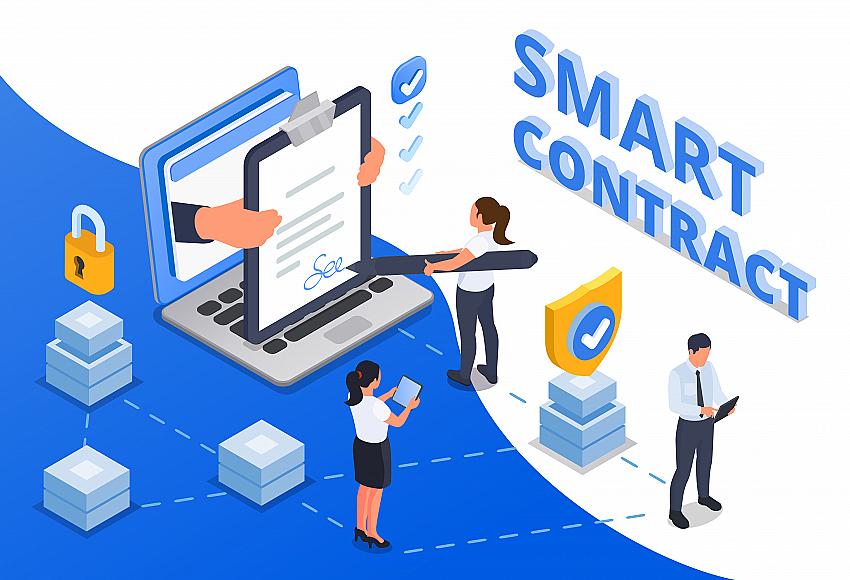
Smart contracts are rapidly becoming a mainstream tool for businesses around the world. Major companies already rely on them to track products across supply chains, cutting processing times from days to seconds and significantly improving efficiency. In the broader context of blockchain and digital transformation, smart contracts stand out as one of the most promising innovations, reshaping how agreements are executed, verified, and enforced without the need for intermediaries.
What Are Smart Contracts?
While the term smart contract is widely used, it is not understood in a single, uniform way. Computer scientists and lawyers often approach the concept from different angles. In legal contexts, the contract refers to a specific set of rights and obligations between parties, whereas in computer science, smart contracts are typically viewed as pieces of code that automate certain actions.
At their core, smart contracts are self-executing agreements where the terms are directly written into lines of code. They operate on blockchain networks (most commonly Ethereum) and automatically perform actions when predetermined conditions are met. Because they run on decentralized blockchain infrastructure, they do not rely on a central authority. As a result, they can reduce or eliminate the need for intermediaries in the execution of agreements.
Brief history and origins
The term “smart contracts” was first introduced by a computer scientist Nick Szabo in 1994. The concept was proposed as a more functional alternative to traditional paper-based contracts. Szabo defined smart contracts as computerized transaction protocols that execute the terms of a contract. To explain his idea, he compared it to a vending machine. When you put money into a vending machine, it automatically gives you an item. No one is involved. The machine simply follows the rules it was programmed with. If you do not put in enough money, you do not get anything. It is straightforward, clear, and fair.
However, smart contracts did not become technically feasible until Ethereum launched in 2015. Its programmable, layered infrastructure allowed smart contracts to go beyond traditional agreements and create entirely new business opportunities, bringing Szabo’s vision to life.
This development marked a turning point in the evolution of digital contracts, transforming smart contracts from a theoretical concept into practical technology. From this foundation, smart contracts began to play a significant role in modern blockchain-based systems.
How do Smart Contracts Work?
A smart contract is computer code stored on a blockchain that automatically executes actions when predefined conditions are met. It is used by individuals or organisations who interact through blockchain addresses and approve transactions using cryptographic digital signatures.
The rules are written in conditional logic (“if this happens, then that happens”). For example, if one party sends payment, ownership of a digital asset is automatically transferred. Once agreed upon, a developer programs the smart contract, although many platforms now offer templates and online tools to simplify the process. Unlike a traditional legal contract written in natural language, a smart contract is self-executing code that enforces agreed rules automatically on the blockchain.
Benefits of Smart Contracts
- Automation
One of the main advantages is that smart contracts automatically execute predefined actions once specified conditions are met, without requiring intermediaries. This significantly reduces delays compared to traditional contractual processes.
- Transparency
Another advantage of smart contracts is the guarantee of transparency. A smart contract is visible to everyone in the blockchain network. Therefore, all participants in a smart contract can see the terms and conditions of the smart contract alongside the changes.
- Cost savings
Removing intermediaries from contract validation and execution significantly lowers costs. This is especially beneficial for small and medium-sized businesses seeking to make more efficient use of their resources.
Limitations of Smart Contracts
- Immutability and Code Errors
Once deployed on a blockchain, smart contracts are generally immutable. Their code and operating logic cannot easily be altered. If an error or vulnerability exists, correcting it may require deploying a new contract, and any damage caused may be irreversible.
- Lack of Flexibility
Smart contracts run automatically on preset if/then rules, leaving no room to account for context, intent, or good faith the way traditional contracts do. Unlike traditional contracts, which allow for interpretation, negotiation, smart contracts cannot be changed once deployed. For example, in cases of system errors, force majeure events, or an honest mistake by one party, a smart contract will still execute exactly as programmed.
- Technical Complexity
Smart contracts require advanced technical skills to build and implement, which can limit accessibility for businesses and individuals. These contracts are programmed in specialized languages like Solidity and require deep understanding of blockchain logic, secure coding practices, and network-specific skills that are much more advanced than traditional contract drafting. Without rigorous testing and auditing, even minor errors can create vulnerabilities that are extremely difficult to correct after deployment.
As digital transformation continues to reshape global commerce, smart contracts illustrate how technology can redefine the way trust and agreement are established. While they are not without challenges, their ability to automate execution and operate within decentralized systems signals a meaningful shift in contractual practice. Rather than replacing traditional legal frameworks entirely, smart contracts are likely to coexist alongside them, contributing to a more efficient and technologically integrated future of transactions.