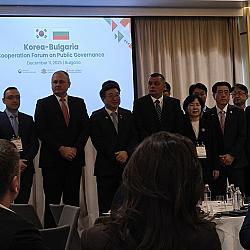
On December 11, 2025, Sofia hosted the Bulgarian- Korean Cooperation Forum on “Improving Digital Transformation and Public Safety” which brought together high-level representatives, experts, and innovators from both countries who shared experience and best practices in the field of digital governance, cybersecurity, and public safety.
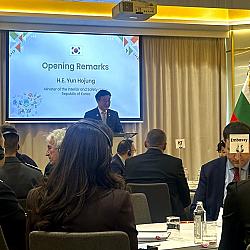
Organized jointly by the Ministry of e-Government and the Ministry of Interior of the Republic of Bulgaria, in cooperation with the Ministry of Interior and Safety of the Republic of Korea, the Forum opened a new stage in the history of bilateral collaboration on technology, innovation, and resilience in public administration. Notably, the Minister of the Interior and Safety of the Republic of Korea, H.E. Yun Hojung, presented the opening remarks before the panel discussions started. Representatives of the Law and Internet Foundation attended the forum to follow the discussions and developments in the areas of AI, cybersecurity, and innovation.
A Common Vision on Public Governance
The forum afforded the opportunity for sharing bilateral experiences on a few important topics:
- The provision of public services through electronic identification;
- The role of trust and efficiency regarding AI, data, and cybersecurity applications in egovernance;
- Public safety and forest fire mitigation strategies frame part of the broader approach to policy architecture dealing with climate resilience.
Panel I: Public Services through electronic identification
The South Korean delegation introduced the recognised model of digital government-Korea-where 98% of adults regularly use electronic public services. South Korea has continuously developed its digital administration since the 1960s, focusing on efficiency, transparency, and citizen empowerment.
The South Korean experts gave insight into their electronic identification system, which has very strong encryption and verification of identity data right on the spot. In 2015, South Korea implemented mobile identification that enables citizens to securely use public and private services using their smartphones. Nowadays, it is possible to identify one's person with just a simple barcode, while independently keeping control over personal data-your own data.
The discussion also covered the Bulgarian eHealth digital health initiative. Through secure electronic identification, citizens have access to their electronic patient records, improving healthcare both in terms of efficiency and continuity.
Panel II: AI, Data & Cybersecurity: Trust and Efficiency in e-Governance
The second panel of the forum brought together speakers who shared their views on the overall AI race globally. Representatives of South Korea shared that country’s readiness to adopt AI in its public administration. It was highlighted that as of 2024, AI has been adopted by 243 out of 401 public institutions in South Korea. The strengths and weaknesses of such an AI adoption were analysed by those speakers.
The Bulgarian representatives, on the other hand, shared that State’s Cybersecurity strategy, the creation of the Information Sharing and Analysis Center, and information on the National Coordination Centres.
Panel III: Public Safety and Forest Fire Mitigation
A full session of the forum was devoted to public safety and forest fire mitigation measures within national and regional strategies for climate resilience. The two sides-Bulgaria and the Republic of Korea-shared experience, data, and best practices in disaster prevention, early warning systems, and emergency response management.
The talks emphasized an increased inclusion of digital technologies in the process of prediction and mitigation, using remote sensing, data analytics, and AI-based risk modelling for the impact of natural hazards. Participants stressed that forest fire prevention and timely intervention are crucial elements of climate resilience, requiring strong coordination among government institutions, local authorities, and the public. Among the participants were representatives of the Bulgarian Fire Safety and Civil Protection Directorate-General, who shared experience from Bulgaria's contribution to the management of wildfires and cross-border cooperation in crisis situations. South Korean experts, in turn, presented the most innovative solutions used in their country: real-time satellite monitoring, drone surveillance, and AI-supported forecasting tools for early detection of fire risks.
The forum concluded by reaffirming the shared commitment of both countries to enhancing digital governance, cybersecurity, and public safety.