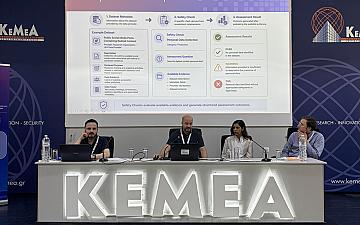
The role of data in Europe’s defence architecture was a key topic of discussion during the Data Spaces Symposium, where representatives from the European Commission, the European Defence Agency (EDA), Siemens, Airbus, and the Aerospace, Security and Defence Industries Association of Europe (ASD) exchanged views on the future of defence data ecosystems. Representatives of LIF attended the session, which offered valuable insights into the strategic, regulatory, and technological dimensions of a European Defence Data Space.
The discussions highlighted a clear message: modern defence capabilities are increasingly defined not only by hardware, but by software and data. In this evolving landscape, a European Defence Data Space is emerging as a strategic enabler - supporting AI deployment, strengthening industrial competitiveness and reinforcing Europe’s strategic autonomy.
Data as a Capability Enabler for Defence
Defence capabilities today are increasingly software- and data-defined. From command and control systems to logistics, predictive maintenance, cyber defence and autonomous platforms, operational effectiveness depends on access to high-quality, timely, and interoperable data.
Importantly, data is not only relevant at the innovation stage. It enhances effectiveness across the entire lifecycle of defence systems - design, development, deployment, sustainment, and upgrading. Without structured data access and governance, higher defence spending alone does not automatically translate into improved capability.
In short: data has become a core operational asset.
Why Defence Data Is Multi-Dimensional
Unlike many civilian sectors, defence data presents unique structural complexity:
It originates from multiple sources - public authorities, private industry, and mixed public-private partnerships.
It supports diverse functions - from design and testing to operations, maintenance, and multinational cooperation.
It carries different levels of sensitivity and risk, including classified information, export-controlled technologies, and commercially sensitive industrial data.
This multi-dimensional character requires governance models that go beyond traditional data-sharing agreements. It demands trusted infrastructures capable of managing varying access rights, classification levels, and sovereignty constraints.
The Case for a European Defence Data Space
A European data space for defence seeks to enable controlled data sharing without loss of authority or competitiveness. The objective is not centralisation, but coordination.
Key principles include:
Trust between public authorities and industrial actors
Cooperation at scale without dependency
Federated and decentralised architectures
Sovereign control over data access and use
Federated data spaces allow organisations to retain control over their data while enabling secure, interoperable transactions across participants. Such an approach strengthens resilience in the European defence technological and industrial base while avoiding structural overdependence on external infrastructures.
Defence AI Data Space (DAIDS): Addressing Fragmentation
The proposed Defence AI Data Space (DAIDS) directly responds to a core challenge: fragmentation.
Modern defence systems rely heavily on AI-enabled and data-driven technologies. Yet defence data remains largely fragmented across:
National silos
Legacy systems
Programme-specific environments
This fragmentation limits the effective deployment of AI, slows multinational decision-making, and undermines interoperability during joint operations.
DAIDS aims to address this by enabling controlled and trusted data sharing while fully respecting national sovereignty. It serves as a federated framework for secure, sovereign defence data exchange across Member States.
Alignment with the EDA AI Action Plan
The European Defence Agency’s AI Action Plan outlines a structured pathway for trusted AI adoption in defence. Key elements include:
Development of an AI taxonomy for defence
Creation of an EU-wide defence data space
Standardisation of AI systems
Testing and evaluation frameworks
Ethical and trustworthiness requirements
The Defence Data Space is positioned as foundational infrastructure for these objectives. It provides the governance and technical backbone for secure access to defence data necessary for AI research, development, and deployment.
By supporting lifecycle assurance, testing frameworks, and ethical oversight, the data space acts as a compliance enabler, helping ensure that AI systems deployed in defence contexts are robust, secure, and trustworthy.
Regulatory Alignment: Compliance as a Strategic Asset
Although military operations are generally exempt from certain horizontal EU regulations, the principles embedded in EU digital legislation provide important reference models.
Strategic alignment can be observed with:
The AI Act - DAIDS can function as a compliance accelerator for dual-use and general-purpose AI components by embedding lifecycle assurance and oversight mechanisms.
The Data Act - Concepts such as cloud and edge switching, safeguards against unlawful third-country access, and sovereign hosting align with defence data sovereignty objectives.
The Data Union Strategy - The notion of Data Labs linking data spaces with AI services reinforces the ecosystem approach.
Rather than viewing compliance as a constraint, the defence data space frames it as a strategic asset - strengthening trust, interoperability, and international credibility.
Data Sovereignty as a Strategic Enabler
At the heart of the Defence Data Space lies the principle of data sovereignty.
In defence, sovereignty is not isolation. It means:
Retaining authority over who accesses data and under which conditions
Ensuring secure hosting and protection against unlawful external access
Enabling multinational cooperation without loss of strategic control
Federated and decentralised architectures allow Europe to scale collaboration while maintaining national control. This balance is crucial for strengthening Europe’s defence industrial competitiveness and technological autonomy.
The Way Ahead: From Concept to Operational Ecosystem
The transition toward a fully operational European Defence Data Space will require:
Interoperability standards across Member States
Harmonised governance frameworks
Trusted technical infrastructures
Clear classification and access management models
Strong public-private cooperation
At the same time, the defence sector operates under heavy regulatory intensity - export controls, classified information regimes, procurement laws, and security clearances. Any operational data space must integrate these realities by design.
If successfully implemented, Europe’s Defence Data Space can:
Accelerate AI-enabled military capabilities
Strengthen resilience of the defence industrial base
Improve multinational operational readiness
Reduce structural technological dependencies
Conclusion
Europe’s Defence Data Space is more than a digital infrastructure initiative. It is a strategic instrument for military innovation and geopolitical autonomy.
By enabling secure, sovereign, and interoperable data sharing, it lays the foundation for trustworthy AI in defence, enhanced interoperability, and scalable cooperation across Member States.
In an era where defence capabilities are increasingly defined by data, building trusted data ecosystems is no longer optional - it is central to Europe’s strategic future.