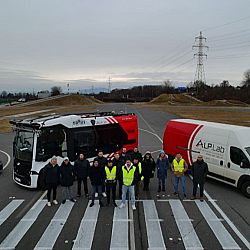
Between February 16 and 20, 2026, the iDriving consortium achieved a major milestone during the Pilot 1 testing phase. The intensive five-day trials focused on evaluating real-time hazard and violation detection systems, bringing the project one step closer to its vision of intelligent, risk-anticipating roadways.
The testing week kicked off at the Torus bus garage, focusing on physical setup and system integration. Drones operated by Acceligence successfully captured traffic footage, working in tandem with simulation models to generate and display accurate messages on Variable Message Signs (VMS). The helmet violation pipeline proved its efficiency right out of the gate, successfully identifying an e-scooter rider without a helmet and instantly triggering VMS warnings. The same tool also performed exceptionally well through the Torus bus onboard cameras, noting an improved detection time. While initial seatbelt and mobile phone detection tests faced real-world challenges - such as windshield reflections and suboptimal camera angles-on-the-spot model retraining allowed the system to successfully detect seatbelt non-compliance by the end of the day.
On the second day, operations moved to the Magna test-track, where Alp.Lab marked specific lanes to simulate a real-world intersection. During the congestion management scenarios, the system successfully detected vehicles via drone and static cameras, prompting the VMS to suggest alternative routes for congestion relief. The pipeline also flawlessly identified red-light running and wrong-lane usage by the test vehicles, propagating warning messages to both the VMS and the iDriving mobile application. Further testing for seatbelt and mobile phone usage was postponed to the following day to address challenging lighting conditions and reflections.
Day 3 marked a significant success, with the majority of core scenarios fully completed and recorded from multiple perspectives. By adjusting camera angles to combat intense sunlight and ground reflections, the system successfully detected seatbelt violations, boasting a rapid 3-second delay between detection and the VMS warning. In-vehicle communication was validated when Simavi’s tablet application successfully alerted the driver of a wrong-lane violation. Furthermore, the Torus bus proved highly effective in dynamic scenarios; its side cameras successfully detected seatbelt violations from a van passing in the adjacent lane.
The consortium dedicated the fourth day entirely to mastering the complex mobile phone usage detection scenario. The team combined resources, utilizing static cameras, drones, and the Torus bus cameras to pinpoint the causes of previous misdetections. After extensive testing and continuous model retraining throughout the day, the system achieved reliable detection of the driver’s mobile phone usage. Through this rigorous process, the team successfully identified the optimal camera specifications, positioning, and lighting setups required for this challenging metric.
The final day of the pilot faced unexpected extreme weather, with heavy snowfall significantly limiting on-track testing. Partners shifted their focus to data consolidation, log verification, and internal performance reviews.
With the successful conclusion of the Austrian trials, the iDriving project is already gearing up for its next major milestone. The upcoming Pilot 2 is set to take place in Nevers, where we will continue to test and refine our next-gen technologies in new environments.
Stay tuned and keep following our journey as we drive innovation forward for safer European roads!