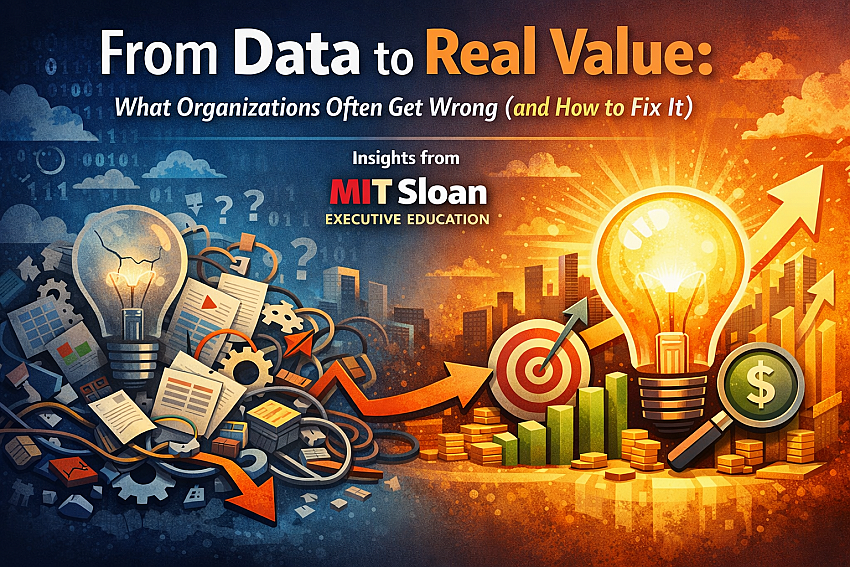
In an economy where data becomes more and more important for economic growth, innovation and competition, learning how to extract its value is a crucial skill. One of the most prestigious universities in the world – the Massachusetts Institute of technology has created a specialised course “The Data Monetization Strategy: Creating Value Through Data” in order to explore how organizations can create financial value from data. But why is data so important, after all?
Data is often called “the new oil” but unlike oil, data has no value on its own. Its value emerges only when organizations know how to use it, why they use it, and who is accountable for the results. This blog post summarizes key lessons from Module 1 of MIT Sloan’s specialized training on data monetization, with practical examples that matter for both private and public-sector organizations.
Three Ways to Think About the Value of Data
MIT researchers explain that organizations usually see data through three complementary lenses.
Data as Capital (Not as a Pile of Files)
Data is best understood as organizational capital - similar to knowledge, processes, or reputation. Most importantly: unused data has no value and value exists only when data leads to measurable outcomes. Researchers from MIT identify five forms of capital that organizations constantly convert into one another: (1) Human capital (skills and expertise), (2) Social capital (networks and trust), (3) Symbolic capital (reputation and credibility), (4) Organizational capital (processes and systems) and economic capital (financial resources).
Data falls under the category of organizational capital, but it becomes economically valuable only when it is actively used to improve decisions, services, or products. What this means in practice is that collecting data is not the strategy of the future. Collecting and using data purposefully is the way towards economic growth and stability.
Data as Impact (Why Better Decisions Matter)
Many organizations experience data value not immediately in money, but in impact: faster response times, lower operational costs, better services for users or citizens and reduced risks and errors. A powerful example comes from manufacturing. By analyzing operational data across several facilities, one global company discovered a hidden inefficiency in packaging waste. This insight led to recycling partnerships that saved over USD 1 million in just two years, while also improving sustainability outcomes. This shows an important lesson - impact often comes first- financial value follows later.
Data as Capital Conversion (How Value Finally Becomes Financial)
MIT emphasizes that the new understanding of what data is has created a new way of creating value by changing how work is done, how products are delivered and what new services can be offered.
This transformation can happen simultaneously- directly and indirectly. By bettering the processes, lowering the economic costs, improving the trust people have in companies, or by selling data-based services or insights organisations may improve their ability to generate financial value.
Understanding how data converts into financial or societal value is essential for transparency, accountability, and governance, especially in regulated or public-interest sectors.
4. The Improve–Wrap–Sell Framework: A Simple Map for Decision-Makers
MIT Sloan proposes a clear framework that helps organizations avoid confusion and overinvestment.
Improve
Using data to make internal processes better, faster and cheaper. A practical example of that would be reducing waiting times, errors, or administrative burden.
Wrap
Using data to enhance existing products or services such as in the case of analytics dashboards or personalized services.
Sell
Using data to create entirely new revenue-generating services such as in data-driven plaforms or information services.
Most organizations fail because they try to do all three at once, without clarity or accountability.
A Real-World Example: Data Saving Lives (and Money) in Healthcare
One of the most striking case studies comes from the healthcare sector.
A large non-profit hospital system in the United States used IoT devices and data analytics to redesign hospital rooms and workflows. The results were concrete and measurable:1
- 57% faster nurse response times
- 12% increase in patient satisfaction
- 29.7% reduction in C. difficile infections
- 24.5% reduction in MRSA infections
- Over 14.5 million monitored hand-hygiene actions in three years
These outcomes improved patient safety, reduced costs, and strengthened public trust - all through careful experimentation, data governance, and clear outcome measurement. This is what economically responsible use of data looks like in practice.
Why Measuring Data Value Is a Governance Issue
One alarming statistic stands out:
63% of CIOs struggle to explain the value of IT and data investments.
When organizations cannot measure data value, this brings:
- bad projects continue unchecked,
- risks remain invisible,
- accountability becomes blurred.
MIT research shows that organizations that compare expected vs. actual outcomes are far better at prioritizing ethical, effective, and sustainable data initiatives. For public institutions, NGOs, and regulators, this is not just a management issue- it is a rule-of-law and trust issue.
What This Means for Policy, Law, and Society
From a legal and governance perspective, the MIT lessons are clear:
- Data must be treated as a strategic asset, not a technical by-product
- Value creation must be measurable and explainable
- Accountability must be clearly assigned
- Experimentation should be encouraged, but responsibly governed
Whether we talk about AI systems, digital public services, or data-driven regulation, value without accountability is risk. In a changing world, the real question is no longer “Do we have data?” but “What value does our data create and how can we monetize it?” At Law and Internet Foundation this question sits at the heart of the digital rule of law.