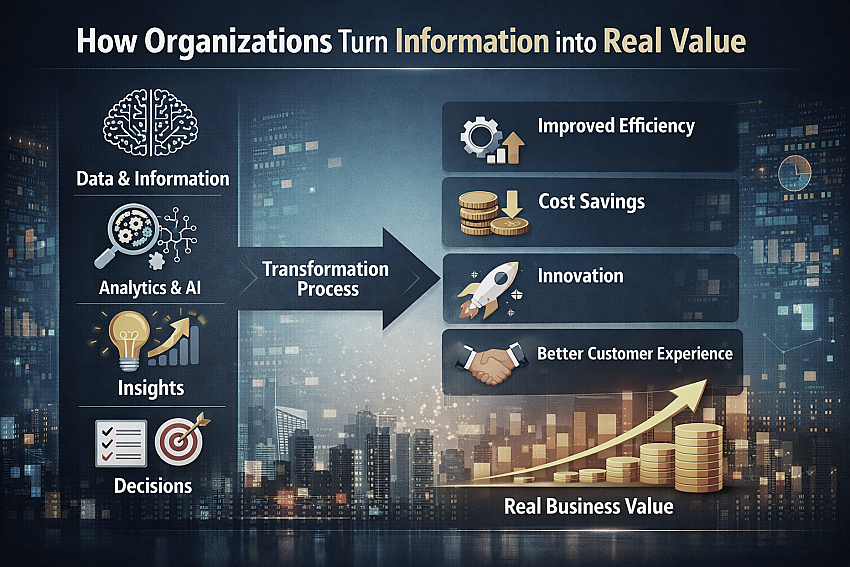
In today’s digital economy, having data alone is no longer the decisive factor. What separates winners from losers is the ability to repeatedly convert data into action and action into measurable value. This idea sits at the heart of Module 2 of the MIT Sloan Executive Education course, which explores how organizations systematically build data monetization capabilities over time. The module examines how a global financial institution BBVA - Banco Bilbao Vizcaya Argentaria, evolved from being data-rich but capability-poor into one of the world’s leaderd of data monetization. The key insight is simple but powerful: data monetization is not a one-off initiative; it is a consistent effort by organisations.
The Data Race Framework: From Data to Action to Value
The data race framework created by MIT offers a structured way to understand how organizations turn information into impact. Each “lap” in the race consists of five essential stages:
- Business purpose -a clearly defined problem or opportunity, with accountable ownership
- Data - assembly and accessibility of relevant, high-quality data
- Insight - analysis that generates actionable understanding
- Action - leadership-driven change that embeds insights into decisions and behaviors
- Business value - measurable improvements in processes, products, or offerings.
Completing all five stages constitutes a full lap. Many organizations collect data and generate insights but fail to translate them into action. This is where most data initiatives stall, and where winners and losers in the data race are ultimately separated.
BBVA’s Starting Point: Data Without Capabilities
BBVA’s journey began with a familiar challenge: an abundance of transactional data, but limited capability to monetize it effectively.
Founded in 1857 as the Bank of Bilbao, BBVA grew into a global financial group with a strong presence in Spain and Latin America. By the early 21st century, rapid international expansion, particularly through acquisitions in the United States and Asia, had increased both the volume and complexity of its data landscape.
Recognizing the economic potential of data, BBVA took a decisive step in 2014 by establishing a dedicated data monetization center of excellence. The rationale behind separating the two enterprises lies in the following:
· Reduced regulatory constraints for the Center compared to the core bank
· Mandatory financial self-sustainability, enforcing economic discipline
· Data positioned as a strategic asset, not a support function
· Targeted recruitment, training, and retention of scarce data science talent
· A start-up–like culture enabling speed, experimentation, and innovation
Overcoming Obstacles to Value Creation
As BBVA’s experiment progressed, it encountered challenges that are common across many organizations:
- Poorly defined or misunderstood business goals
- Data quality and integration issues
(3) Limited analytical skills and low user engagement
(4) Leadership reluctance to drive organizational change
(5) Weak or absent metrics for measuring value
However, BBVA made a strategic choice- rather than treating these issues as isolated problems, it reframed them as signals of missing enterprise capabilities. It regarded them as obstacles to overcome not stop them. Addressing the obstacles meant strengthening foundational elements such as:
- Data asset management
- Analytics and data science capabilities
- Data platforms and accessibility
- Governance and accountability mechanisms
Crucially, the focus shifted from quick fixes to capability investments, recognizing that this has the potential to lead to a long-term value for the organisation.
BBVA’s Data Race in Practice
BBVA’s approach to data monetization unfolded across several reinforcing phases:
- Selling - Early external data products generated revenue, learning, and credibility
- Improving - Internal optimization initiatives used insights to boost efficiency and performance
- Wrapping - Data-driven insights were embedded directly into existing products and services
Each phase built on the capabilities developed in previous laps. Platforms, governance structures, and organizational knowledge scaled across the enterprise, transforming data monetization from isolated experiments into a core organizational capability.
Building Capabilities Over Time
BBVA’s experience provides a critical lesson: sustained data monetization requires a long-term perspective. Short-term initiatives matter, but their real value lies in how they contribute to broader digital transformation.
Democratized access to data, tools, and insights becomes a competitive advantage only when it is paired with intentional capability-building and aligned with future strategic flexibility.
Winning the Data Race
Organizations that consistently win the data race tend to share several defining characteristics:
- Enterprise-wide participation in data monetization efforts
- Strong leadership commitment and clear accountability
- Rigorous measurement of outcomes and value creation
- Strategic use of early wins to fuel more complex, higher-impact initiatives
Key Takeaway
BBVA’s journey shows that winning the data race is not about speed, it’s about endurance and direction. Data becomes a sustained source of competitive advantage only when it consistently drives action and measurable value.
The guiding question for leaders shifts from “What data do we have?” to:“What capabilities are we building with each data initiative—and how do they prepare us for the next lap?”That mindset, more than any single technology or dataset, is what turns data into real value.